Related Posts Plugin for WordPress, Blogger...
Showing posts with label miscellaneous. Show all posts

Tuesday, October 25, 2011

ICGEB(Malaria vaccine)


Close to the success of a malaria vaccine in Africa, an experimental malaria vaccine developed by Indian scientists is also showing promise.
The vaccine, developed by the International Centre for Genetic Engineering and Biotechnology (ICGEB), is the first malaria vaccine from India to reach the stage of human testing.
The project has been funded by the department of biotechnology and European vaccine initiative, while Hyderabad-based Bharat Biotech has manufactured the vaccine for trials.
The research centre is working on two vaccines - one against Plasmodium falciparum, the parasite which causes deadly brain malaria and the other against Plasmodium vivax.
Under laboratory conditions, these vaccines have produced protective molecules and killed malaria parasite.
The vaccine against falciparum malaria has already entered testing in humans. Phase one clinical studies to test safety and to see whether it evokes immune response have been completed in Bangalore. Three different doses are being tried in three groups of 15 healthy persons each.
"There seem to be no safety issues," Dr V. S. Chauhan, director ICGEB, said.
Though it appears to be safe, data is being analysed and detailed results would be available by next year. If the results are all positive, the experimental vaccine would enter phase two studies to evaluate efficacy.
The vaccine has two proteins of the parasite and is aimed at preventing penetration of the parasite into the blood cells of humans. The parasite enters human body through mosquito bite, goes to liver and then to blood cells. The symptoms of malaria occur when the parasite multiplies in the blood cells.
Attempts are being made to make a vaccine against the disease. We may have to mix vaccines to get a potent mix which will target all stages of the malaria parasite, scientists said.
Scientists say vaccines could be the key to eradicate malaria. Current attempts to develop malaria vaccines are focused on reducing morbidity and mortality. If malaria vaccines are to have an impact on malaria transmission, then they must target parasites both in humans and mosquitoes.


Tuesday, September 13, 2011

Zodiac

 Zodiac

Signs of Zodiac

The orbits of the Moon and the major planets lie entirely within the zodiac. In astrology, each of 12 constellations along this circle is considered to occupy 1/12 (30°) of it. The positions of the Sun and planets when a person is born and their motion through these constellations are said to exert influence on his or her life, though precession of the equinoxes has shifted the constellations eastward, and the Sun no longer passes through them on the traditional dates: Aries, the ram (March 21–April 19); Taurus, the bull (April 20–May 20); Gemini, the twins (May 21–June 21); Cancer, the crab (June 22–July 22); Leo, the lion (July 23–August 22); Virgo, the virgin (August 23–September 22); Libra, the balance (September 23–October 23); Scorpius (see Scorpio), the scorpion (October 24–November 21); Sagittarius, the archer (November 22–December 21); Capricornus (see Capricorn), the goat (December 22–January 19); Aquarius, the water bearer (January 20–February 18); Pisces, the fish (February 19–March 20
.source:Britannica encyclopedia

Sunday, September 4, 2011

Atlsntic Ocean


Atlsntic Ocean
Ocean separating North and South America from Europe and Africa.

The second largest of the world's oceans, the Atlantic has an area of 31,830,000 sq mi (82,440,000 sq km). With its marginal seas, including the Baltic, North, Black, and Mediterranean to the east, and Baffin 


Bay, Hudson Bay, the Gulf of St. Lawrence, Gulf of Mexico, and Caribbean Sea to the west, it covers some 41,100,000 sq mi (106,450,000 sq km). Including these latter bodies of water, its average depth is 10,925 ft (3,330 m); its maximum depth is 27,493 feet (8,380 m) in the Puerto Rico Trench. Its most powerful current is the Gulf Stream.

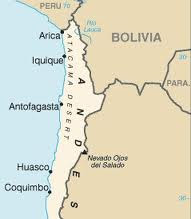
Atacama Desert


Atacama Desert (chile)
 Cool, arid area, north-central Chile.


Extending north from the city of Copiapó, the area runs from north to south for a distance of some 600 to 700 mi (1,000 to 1,100 km) and covers most of the Antofagasta region and the northern part of the Atacama region. 

Because of its location between low coastal mountains and a higher inland range, the region is meteorologically anomalous. Despite its low latitude, summer temperatures average only about 65 °F (18 °C), and, though heavy fogs are common, the desert is one of the driest regions in the world. Some areas receive heavy rain only two to four times a century. For much of the 19th century, the desert was the object of conflicts between Chile, Bolivia, and Peru; after the War of the Pacific (1879–83), Chile emerged with permanent ownership of sectors previously controlled by Peru and Bolivia. For years before the development of synthetic methods of fixing nitrogen, the desert was a chief source of the world's nitrates.


Thursday, September 1, 2011

Arches National Park


Arches National Park
Preserve, eastern Utah, U.S.


Located on the Colorado River north of Moab, the preserve was established as a national monument in 1929 and as a national park in 1971. Its area is about 120 sq mi (310 sq km). The park's sandstone has been eroded into unusual shapes, including Courthouse Towers, Fiery Furnace, and Devils Garden, the site of Landscape Arch, at 306 ft (93 m) the longest freestanding natural rock bridge in the world.
Source:Britannica encyclopedia

Aral sea


Aral sea
Large salt lake between Kazakhstan and Uzbekistan.


It once covered some 26,300 sq mi (68,000 sq km) and was the fourth largest inland body of water in the world, but diversion of the waters of the Syr Darya and Amu Darya rivers for irrigation has led to an overall reduction of its surface area by more than half since 1960. Its volume has been reduced drastically, which has led to an increase in salinity. The soil of the dried-up lake bed has been found to contain salts and other toxic substances.
Source: Britannica encyclopedia

Arabian Peninsula


Arabian Peninsula
or Arabia

Peninsular region, southwest Asia.


With its offshore islands, it covers about 1 million sq mi (2.6 million sq km). Constituent countries are Bahrain, Kuwait, Oman, Qatar, United Arab Emirates, Yemen, and, the largest, Saudi Arabia. It is generally arid and is covered almost entirely by the Arabian Desert. The modern economy is dominated by the production of petroleum and natural gas. The world's largest proven reserves of those minerals are in the Arabian Peninsula. Its political consolidation was begun by the Prophet Muhammad, and it was the centre of the orthodox caliphate until 661, when that office passed to the Umayyad dynasty in Damascus. After 1517 much of the region was dominated by the Ottoman Empire, though the peninsula's people, who had remained largely tribal and nomadic, revolted repeatedly until the World War I (1914–18), when the Ottoman Empire dissolved. Thereafter, individual nation-states followed their own histories, though many maintained close ties with European powers such as the United Kingdom.

. At least one-third of the desert is covered by sand, including the Rubʿ al-Khali, considered to have one of the most inhospitable climates on Earth. There are no perennial bodies of water, though the Tigris-Euphrates river system lies to the northeast and the Wadi ajr is located to the south, in Yemen. Humans have inhabited the area since Pleistocene times.

Source: Britannica encyclopedia

Arabian desert


Arabian desert
Desert region, Arabian Peninsula.

Photograph:The Rubʿ al-Khali sand desert, most of which lies within Saudi Arabia.
The Rubʿ al-Khali sand desert, most of which lies within Saudi Arabia.


It covers about 900,000 sq mi (2,330,000 sq km), occupying nearly the entire peninsula. It lies largely within Saudi Arabia but large portions extend into Jordan, Iraq, Kuwait, Qatar, the United Arab Emirates, Oman, and Yemen. Its relief is broken by a number of mountain ranges, with elevations reaching as high as 12,000 ft (3,700 m), and it is bounded on three sides by high escarpments. At least one-third of the desert is covered by sand, including the Rubʿ al-Khali, considered to have one of the most inhospitable climates on Earth. There are no perennial bodies of water, though the Tigris-Euphrates river system lies to the northeast and the Wadi ajr is located to the south, in Yemen. Humans have inhabited the area since Pleistocene times.
Source: Britannica encyclopedia

Appalachian mountains


Appalachian mountains
 Mountain system, eastern North America.


The Appalachians, among the oldest mountains on Earth, extend almost 2,000 mi (3,200 km) from the Canadian province of Newfoundland and Labrador in the northeast southwestward to Alabama in the U.S. They include the White Mountains in New Hampshire, the Green Mountains in Vermont, the Catskill Mountains in New York, the Allegheny Mountains primarily in Pennsylvania, the Blue Ridge Mountains in Virginia and North Carolina, the Great Smoky Mountains in North Carolina and Tennessee, and the Cumberland Plateau extending from West Virginia to Alabama.


Their highest peak is Mount Mitchell in North Carolina. See also Appalachian Geosyncline; Appalachian National Scenic Trail.
Source: Britannica encyclopedia

APEC


APEC
in full Asia-Pacific Economic Cooperation


Trade group established in 1989 in response to the growing interdependence of Asia-Pacific economies and the advent of regional economic blocs (such as the European Union and the North American Free Trade Area) in other parts of the world.


APEC works to raise living standards and education levels through sustainable economic growth and to foster a sense of community and an appreciation of shared interests among Asia-Pacific countries. At the end of the 1990s APEC's membership included its 12 founding members—Australia, Brunei, Canada, Indonesia, Japan, South Korea, Malaysia, New Zealand, the Philippines, Singapore, Thailand, and the United States—as well as Chile, China (including Hong Kong), Mexico, Papua New Guinea, Peru, Russia, and Vietnam; Taiwan also participates as “Chinese Taipei.” The Pacific Economic Cooperation Council, the South Pacific Forum, and the secretariat of the Association of Southeast Asian Nations maintain observer status. The APEC group represents about 40% of the world's population, 40% of global trade, and 50% of the world's gross national product. See also NAFTA; trade agreement; World Trade Organization.
Source: Britannica encyclopedia

Antarctic region


Antarctic regions
Antarctica and the southern portions of the Pacific, Atlantic, and Indian oceans.


The waters around Antarctica are sometimes called the Southern Ocean; however, the term “Antarctic Ocean” is sometimes also used, inappropriately. Much of the area is characterized by subpolar conditions, and ice shelves and sea ice extend well beyond the borders of the continent. Water cooled by the coastal ice masses of the Antarctic continent sinks and flows northward along the ocean bottom and is replaced at the surface by warmer water flowing south from the Indian, Pacific, and Atlantic oceans. The meeting point of these currents is the Antarctic Convergence, an area rich in phytoplankton and krill, which are important to various species of fish as well as to penguins and seabirds.

Antartic Circle
Parallel of latitude approximately 66.5° south of the Equator that circumscribes the southern frigid zone.


It marks the northern limit of the area within which, for one day or more each year, the sun does not set or rise. The length of continuous day or night increases southward from the Antarctic Circle, mounting to six months at the South Pole.

Source:Britannica encyclopedia

Saturday, August 27, 2011

Accordian

Accordian

Portable musical instrument that uses a hand-pumped bellows and two keyboards to sound free reeds, small metal tongues that vibrate when air flows past them.
Photograph:Italian accordion, 19th century

Accordian

  
* Italian accordion, 19th century

The keyboards on either side of the bellows effectively resemble individual reed organs. The right-hand keyboard plays the treble line or lines. Most of the keys on the left-hand (bass) keyboard sound three-note chords; “free-bass” accordions permit the playing of single-note lines. A prototype accordion, using buttons rather than keys, was patented in Berlin in 1822 by Friedrich Buschmann (also inventor of the harmonica). The instrument gained wide popularity in dance bands and as a folk instrument. See also concertina.

Source: Brittanica Encyclopedia

Adi grant


Adi grant


(Punjabi: “First Book”) Sacred scripture of Sikhism.

Adi Grant


Composed of nearly 6,000 hymns of the Sikh Gurus and Hindu and Islamic saints, it is the central object of worship in all gurdwaras (temples). It is ritually opened and closed daily and is read continuously on special occasions. First compiled in 1604 by Arjan, it included his own hymns and those of his predecessors and the devotional songs of saints. In 1704 the last Guru, Gobind Singh, added more hymns and decreed that after his death the Granth would take the place of the Guru. Written mostly in Punjabi or Hindi, it contains the Mul Mantra (basic prayer), Japji (the most important scripture, written by Nanak), and hymns arranged according to the ragas in which they are to be sung.


Amazon river


Amazon river
Portuguese Rio Amazonas

River, northern South America.

Amazon River


It is the largest river in the world in volume and area of drainage basin; only the Nile River of eastern and northeastern Africa exceeds it in length. It originates within 100 mi (160 km) of the Pacific Ocean in the Peruvian Andes Mountains and flows some 4,000 mi (6,400 km) across northern Brazil into the Atlantic Ocean. Its Peruvian length is called the Marañón River; the stretch of river from the Brazilian border to the mouth of the Negro River is the Solimões River. Its more than 1,000 known tributaries rise in the Guiana Highlands, the Brazilian Highlands, and (principally) the Andes; 7 of these are longer than 1,000 mi (1,600 km), and the Madeira River exceeds 2,000 mi (3,200 km). The Amazon can accommodate large freighters as far upriver as the city of Manaus, Braz., 1,000 mi (1,600 km) from the Atlantic. The first European descent was made by Francisco de Orellana in 1541–42; he is said to have given the river its name after reporting battles with tribes of women, whom he likened to the Amazons of Greek legend. Pedro Teixeira achieved the first ascent in 1637–38, but the river remained little explored until the mid-19th century. Many indigenous peoples originally lived along the river, but they moved inland as exploring parties and raiders (see bandeira) sought to enslave them. The river was opened to world shipping in the mid-19th century; traffic increased exponentially with the coming of the rubber trade, which reached its height c. 1910 but soon declined. Its basin encompasses the world's most extensive rainforest and is home to an extraordinary diversity of birds, mammals, and other wildlife. Since the 1960s the effects of economic exploitation on the region's ecology and the destruction of the rainforest have generated worldwide concern.source:Britannica encyclopedia

Kofi Annan


Kofi annan( Ex seceratry general of UNO)
 born April 8, 1938, Kumasi, Gold Coast


Seventh secretary-general of the United Nations (1997–2006), who shared, with the UN, the 2001 Nobel Prize for Peace.

Kofi Annan

He was the son of a provincial governor and hereditary paramount chief of the Fante people. He did graduate work at Geneva's Institute for Advanced International Studies and at MIT. He has spent almost his entire career within the UN, beginning at the World Health Organization (1962). As undersecretary-general for peacekeeping (from 1993), he transferred peacekeeping operations in Bosnia from the UN to NATO. Elected in December 1996, he became the first UN secretary-general from sub-Saharan Africa, and he enjoyed a mandate to reform the UN bureaucracy. He criticized the UN's failure to prevent or minimize genocide in Rwanda (1994) and unsettled many by declaring that the UN should address human-rights violations perpetrated by governments against their own people. His priorities included restoring public confidence in the organization and strengthening the UN's activities for peace and development. Annan was appointed to a second term in 2001, and terrorism and global security became major issues following the September 11, 2001, attacks in the U.S. He also oversaw the adoption of a number of reforms, including many institutional and administrative changes, though some measures, such as the expansion of the UN Security Council, were rejected. Annan left office in 2006, succeeded by Ban Ki-moon.

Source: Britannica encyclopedia

Thursday, August 25, 2011

Angel falls


Angel falls
Waterfall, southeastern Venezuela.

Angel Falls,Venezuela


Photograph:Angel Falls (Salto Ángel), La Gran Sabana region of Bolívar state, Venezuela
* Angel Falls (Salto Ángel), La Gran Sabana region of Bolívar state, Venezuela.

It lies on the Churún River, a tributary of the Caroní, southeast of Ciudad Bolívar. The highest waterfall in the world, the cataract drops 3,212 ft (979 m) and is 500 ft (150 m) wide at its base. It was named for James Angel, an American who crash-landed his plane nearby in 1937.
Source: Britannica encyclopedia

Aldrin Edwine

Aldrin Edwine
known as Buzz Aldrin
born Jan. 20, 1930, Montclair, N.J., U.S.

Buzz Aldrin


U.S. astronaut.
He graduated from West Point and flew 66 combat missions in the Korean War. In 1963 he received a Ph.D. from MIT and was chosen as an astronaut. In 1966 he joined James A. Lovell, Jr. (b. 1928) on the four-day Gemini 12 flight. Aldrin's 51/2-hour walk in space proved that humans can function effectively in the vacuum and weightlessness of space. In July 1969, on the Apollo 11 mission, he became the second human to walk on the Moon.